AI KOL Management Platform vs Traditional Tools: An Objective Comparison
If you're researching how to manage influencer campaigns more efficiently, you've probably encountered at least four different options: spreadsheets, traditional influencer databases, agencies, and the newer category of AI KOL management platforms.
Each has trade-offs. The right choice depends on your team size, campaign volume, budget, and strategic goals.
This guide gives you an objective side-by-side comparison so you can make an informed decision — without the marketing fluff.
The Four Main Approaches to Influencer Management
Before comparing features, here's a quick definition of each approach:
1. Spreadsheets and Manual Tools Google Sheets, Notion, email, and DMs. The default starting point for most teams.
2. Traditional Influencer Databases Platforms focus on creator discovery and basic campaign tracking.
3. Influencer Marketing Agencies Full-service human teams that run campaigns on your behalf.
4. AI KOL Management Platforms The emerging category that combines discovery, outreach automation, project management, CRM, and analytics in one AI-powered system.

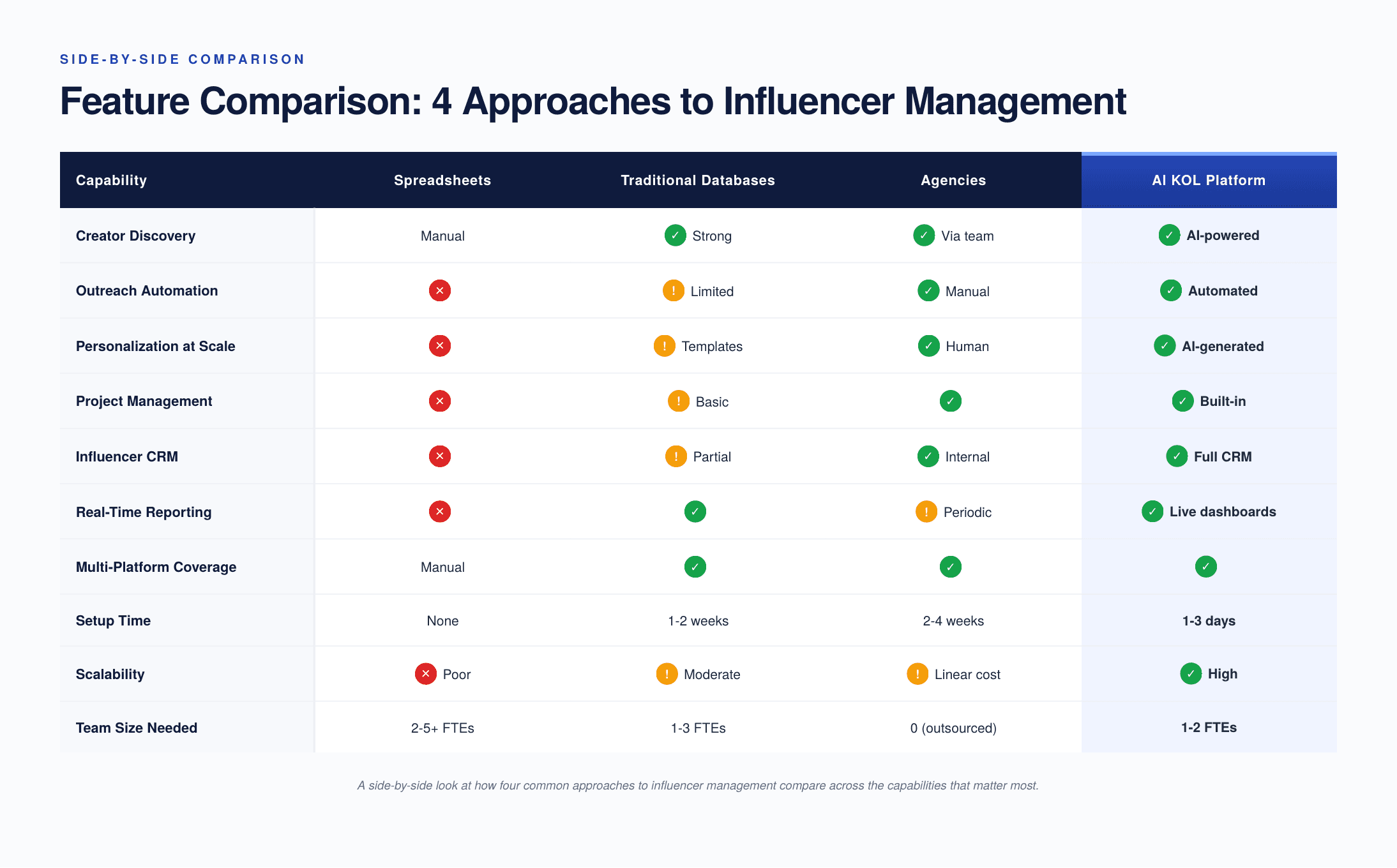
Side-by-Side Feature Comparison
Cost Comparison
Cost varies significantly across approaches. Here's a realistic breakdown for a brand running 20 creator campaigns per quarter:
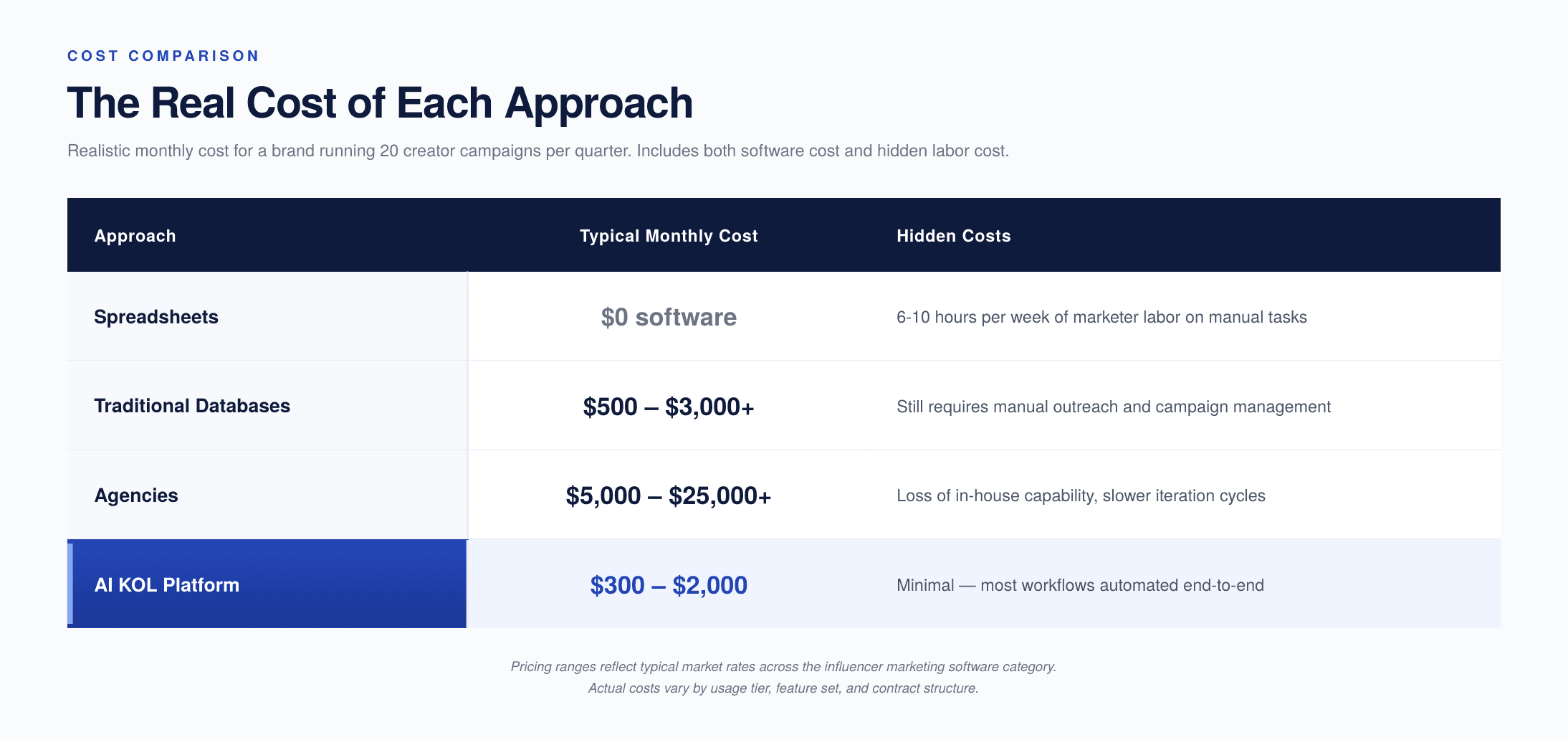
The true cost of spreadsheets isn't zero — it's the opportunity cost of a marketer spending 8-10 hours per week on manual reporting alone (Archive, 2026), with additional hours lost to discovery, outreach, and follow-up management.
Speed of Execution: A Real-World Scenario
Based on typical execution timelines reported by teams using each approach, here's how a 30-creator activation in 14 days compares:
With spreadsheets: Likely impossible without a dedicated team. Most brands take 4-6 weeks.
With a traditional database: Discovery is fast, but outreach, negotiation, and tracking still take 3-4 weeks.
With an agency: Typically 3-5 weeks depending on the agency's bandwidth.
With an AI KOL management platform: Achievable in 10-14 days because discovery, outreach, follow-ups, and project tracking happen in parallel automatically. Industry research shows automated workflows reduce execution time by around 70% (Archive, 2026).
For brands running rapid product launches or seasonal campaigns, this speed difference is often the deciding factor.
When Each Option Makes Sense
Choose spreadsheets if: You're running fewer than 5 campaigns per year and don't plan to scale. You're just testing the channel.
Choose a traditional influencer database if: You need creator discovery but already have strong internal processes for outreach and project management. You're a large enterprise with custom workflows.
Choose an agency if: You have budget but no internal team, and you want to outsource the entire function. You're early in your influencer marketing journey and want experienced operators.
Choose an AI KOL management platform if: You want to build in-house capability, scale efficiently with a lean team, and need real-time visibility into campaigns. You're running 5+ campaigns per quarter or expect to.

What AI KOL Platforms Do That Others Can't
The defining advantages of AI KOL management platforms over the alternatives:
Personalization at scale — Traditional tools force you to choose between scale and personalization. AI eliminates this trade-off.
Always-on operations — Outreach, follow-ups, and reminders run 24/7 without human input.
Unified data layer — Everything in one place, from first outreach to final invoice.
Continuous learning — The system improves with each campaign as it learns what works for your brand.
Faster team onboarding — New team members can run campaigns within days, not months.
Common Objections to Switching
"AI will make outreach feel generic." The opposite is true when done right. AI can reference specific content from each creator that a human reading 200 profiles would miss.
"Our agency already does this." 66.33% of respondents say their influencer marketing is managed entirely in-house. Another 10.71% report a hybrid model (a mix of in-house + agency), while the same percentage (10.71%) runs it through an agency partner. (Influencer Marketing Hub Benchmark Report 2026)
"We're not ready for AI." "AI" here is just automation in a smarter wrapper. If you've ever used email marketing software, you've used something conceptually similar.
The Bottom Line
There's no universally "best" option — there's only what fits your team's stage and goals.
But for most modern marketing teams running regular influencer campaigns, the math favors AI KOL management platforms: lower cost than agencies, more capability than databases, and dramatically faster than spreadsheets.
Curious how it compares for your specific use case? Book a personalized demo and we'll walk through a side-by-side comparison based on your current workflow.
Sources
Influencer Marketing Hub Benchmark Report 2025/2026: https://influencermarketinghub.com/influencer-marketing-benchmark-report/
Archive — Influencer Marketing Automation: https://archive.com/blog/influencer-marketing-automation
Archive — How to Automate Influencer Campaign Reporting: https://archive.com/blog/automate-influencer-campaign-reporting
Statista — Global influencer marketing market size: https://www.statista.com/statistics/1092819/global-influencer-market-size/
FAQ Section
Q: Can I use an AI KOL platform alongside my existing agency? Yes, and many brands do exactly this. The platform becomes the shared operating system between your in-house team and external partners.
Q: How does an AI KOL platform compare to traditional influencer databases? Traditional influencer databases focus primarily on discovery and reporting. AI KOL management platforms add outreach automation, generative messaging, and full project management on top of those capabilities — moving from a search tool to a complete operating system.x
Q: Will switching from spreadsheets disrupt my current campaigns? No. Most platforms offer guided imports of your existing creator lists, contacts, and campaign data. Migration typically takes a few hours.
Q: Is an agency more reliable than software? Agencies offer human judgment, but they're also more expensive, slower to scale, and create knowledge gaps when contracts end. Software with AI gives you operational consistency that doesn't leave when staff turn over.
Q: What's the ROI on switching to an AI KOL platform? Industry research backs this up. According to Archive's 2026 automation report, teams using automated workflows reduce campaign execution time by approximately 70% — and modern automation handles 80-90% of campaign logistics (content capture, vetting, tracking). The Influencer Marketing Hub Benchmark Report 2025 found that 66.4% of marketers using AI tools report improved campaign outcomes.