How to Automate Influencer Outreach: A 7-Step Playbook for Marketing Teams
Manual influencer outreach is one of the most time-consuming bottlenecks in modern marketing. Industry research shows manual outreach takes 30-45 minutes per creator — meaning a 50-creator campaign consumes 25-40 hours before a single reply comes in (InfluenceFlow, 2026). Marketing managers spend an additional 8-10 hours per week on manual reporting alone (Archive, 2026). That's time that should be spent on strategy, creative direction, and performance optimization.
The good news: nearly every step of the outreach process can now be automated using AI-powered tools and a well-designed workflow.
This playbook walks you through exactly how to automate influencer outreach end-to-end — without losing the personalization that makes campaigns convert.
Why Automating Influencer Outreach Matters
Before diving into the steps, it's worth understanding what you're actually solving. Manual outreach typically breaks down at three points:
Discovery — finding the right creators takes hours of platform scrolling
Personalization at scale — writing tailored messages for 50+ creators
Follow-up management — tracking who replied, who didn't, and when to nudge
A well-built automation workflow addresses all three — and frees your team to focus on relationship-building and creative work.
Here's the 7-step playbook.
Step 1: Define Your Ideal Creator Profile (ICP)
Before automating anything, document exactly who you're looking for. Your ICP should specify:
Niche or content vertical (e.g., beauty, fintech, fitness)
Audience demographics (age, location, gender, interests)
Engagement benchmarks (minimum engagement rate, comment quality)
Content style (educational, lifestyle, comedic, aspirational)
Platform priorities (TikTok, Instagram, YouTube, etc.)
The clearer your ICP, the more accurate your AI-powered discovery will be. Skipping this step is the #1 reason teams get poor results from automation.
Step 2: Use AI to Build Your Initial Creator Shortlist
Plug your ICP into an AI influencer discovery tool to generate your initial list. The right platform should let you filter by:
Audience demographics (not just creator demographics)
Content topic and tone
Past brand partnerships
Engagement quality, not just follower count
Audience authenticity scores
Aim for a shortlist 3 to 5 times larger than the number of creators you want to activate. This gives you room for non-responses and disqualifications.
Step 3: Enrich and Score Each Creator Automatically
Once you have a shortlist, use AI to enrich each profile with:
Contact information (email, management contacts)
Past brand collaborations
Average performance metrics
Audience overlap with your brand
Content sentiment analysis
Then assign each creator a fit score. This lets you prioritize outreach to highest-fit candidates first — instead of treating your shortlist as one undifferentiated list.
Step 4: Generate Personalized Outreach Messages with AI
Generic outreach gets ignored. But personalized outreach at scale is impossible manually.
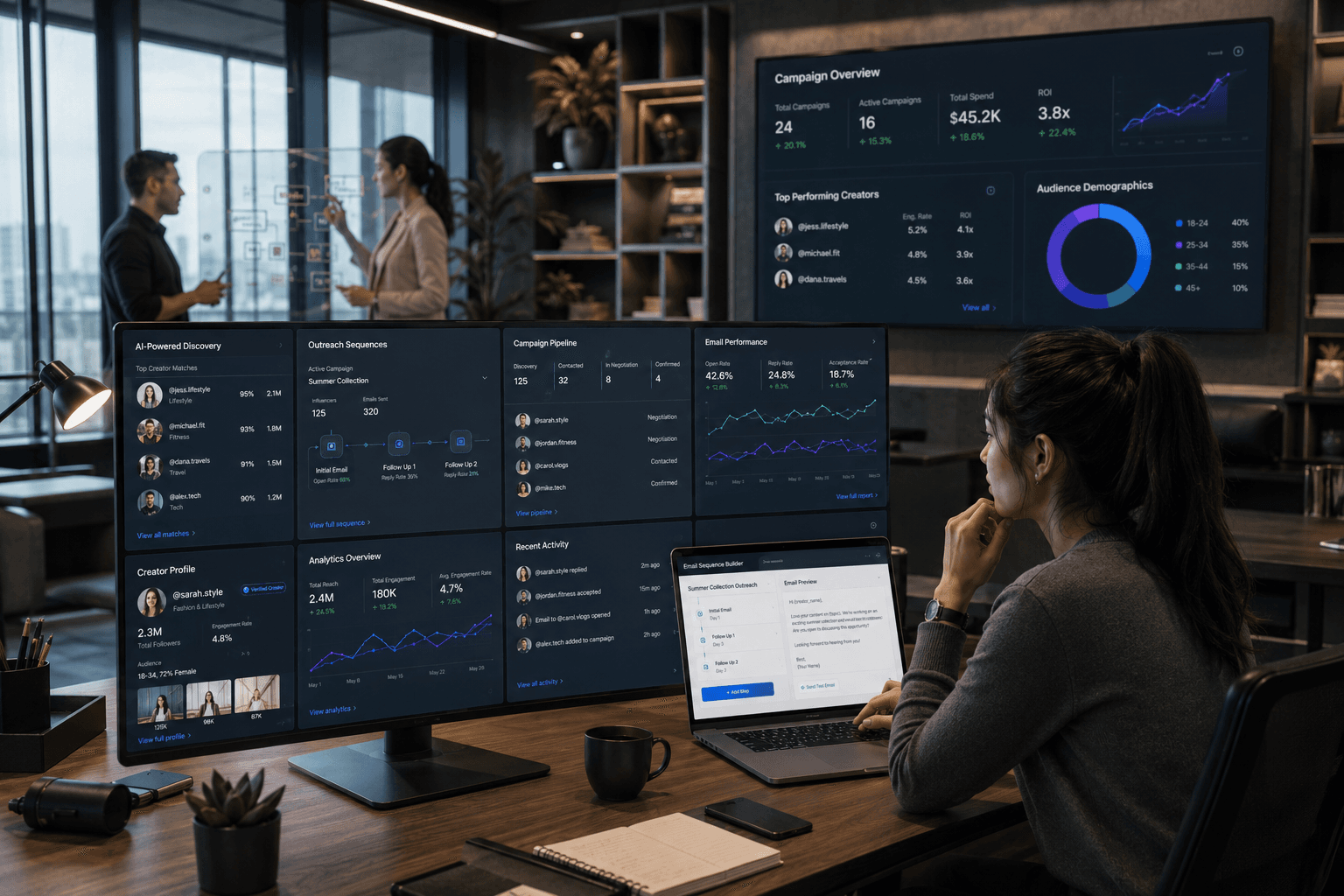
This is where AI delivers its biggest workflow win. A modern AI KOL management platform can:
Reference the creator's recent content in the opening line
Adapt tone based on the creator's communication style
Include relevant offer details based on their tier
Generate 3-5 variations for A/B testing
Best practice: Always have a human review the first batch of AI-drafted messages before sending. After that, you can move to lighter spot-checks.
Step 5: Automate Multi-Touch Follow-Up Sequences
Most replies don't come from the first message — they come from the second or third. A proper outreach automation workflow should include:
Touch 1: Personalized intro (Day 0)
Touch 2: Soft follow-up with added context (Day 3-4)
Touch 3: Value-add nudge with case study or social proof (Day 7-10)
Touch 4: Final close-out message (Day 14)
The platform should automatically pause sequences when a creator replies, and route the conversation to a human.
Step 6: Centralize All Conversations in an Influencer CRM
One of the biggest hidden costs of manual outreach is conversation fragmentation. Replies come in through Instagram DMs, email, LinkedIn, and WhatsApp — and nothing is connected.
An influencer CRM consolidates every touchpoint per creator into a single timeline. You can see:
Every message exchanged
Past campaign history
Negotiated rates
Content performance from previous partnerships
Notes from team members
This becomes invaluable as your creator network grows past 50+ relationships.
Step 7: Measure, Iterate, and Build a Learning Loop
Automation isn't "set and forget." Each campaign generates data that should improve the next one. Track:
Reply rates by message variant
Conversion rates from reply to signed agreement
Time-to-close per creator tier
Performance correlation between fit scores and actual campaign results
Feed these insights back into your ICP and message templates. Over 3-6 months, outreach efficiency compounds meaningfully as the system learns what works — better-fitting creators, higher-converting message variants, faster time-to-close. 66.4% of marketers report improved campaign outcomes through AI integration with the IMH source.
Common Mistakes to Avoid When Automating Outreach
Skipping the ICP step. AI is only as good as the inputs you give it.
Sending without human review. Especially in the first month of using a new tool.
Over-personalizing. Beyond a certain point, personalization adds time without adding reply rate.
Ignoring platform-specific norms. TikTok outreach should not read like LinkedIn outreach.
Forgetting compliance. Disclose partnerships and follow platform terms of service.
The Bottom Line
Automating influencer outreach isn't about removing humans from the process — it's about removing repetitive tasks so humans can focus on the work that actually moves campaigns forward: relationship building, creative direction, and strategic decisions.
Teams that implement this 7-step playbook can expect meaningful efficiency gains. Industry research shows automated workflows reduce campaign execution time by around 70% (Archive, 2026), and 66.4% of marketers report improved campaign outcomes after implementing AI tools (Influencer Marketing Hub, 2025).
Sources
InfluenceFlow — Influencer Marketing Automation Tools Guide 2026: https://influenceflow.io/resources/influencer-marketing-automation-tools-the-complete-2026-guide-9/
Archive — Influencer Marketing Automation: https://archive.com/blog/influencer-marketing-automation
Archive — How to Automate Influencer Campaign Reporting: https://archive.com/blog/automate-influencer-campaign-reporting
Influencer Marketing Hub Benchmark Report 2025: https://influencermarketinghub.com/influencer-marketing-benchmark-report/
Influencer Hero — Achieve 40%+ Reply Rates with Outreach Rules: https://www.influencer-hero.com/blog-detail/achieve-40-reply-rates-with-our-top-5-influencer-outreach-rules
FAQ
Q: How long does it take to set up an automated outreach workflow? With the right platform, you can have a working workflow live within a day. Refining it based on performance takes 4-6 weeks.
Q: Will creators know the outreach is automated? If done correctly, no. The personalization layer is what matters, not whether a human typed each word. The goal is that every message feels relevant to the recipient.
Q: What's a realistic reply rate for automated outreach? Well-targeted, well-personalized campaigns typically see 15-30% reply rates, with follow-ups doubling response rates compared to single-touch outreach (Influencer Hero, 2025). Anything above 30% is excellent; below 10% suggests your ICP or message needs work.
Q: Can I automate outreach across multiple platforms? Yes. A modern AI KOL management platform handles Instagram, TikTok, YouTube, and email simultaneously, with platform-appropriate messaging for each.
Q: Is this approach compliant with platform terms of service? When you use a legitimate platform that respects API limits and platform guidelines, yes. Avoid scraping tools or bulk DM bots that violate platform terms.