Meta just dropped a massive roadblock by officially banning ByteDance from running advertisements across Facebook and Instagram. This restriction hits seven major markets and instantly vaporizes cross-platform paid traffic pipelines for social media marketers. If you relied on Meta Ads Manager to grow your TikTok presence, you now need to pivot aggressively to data-driven organic strategies and competitor benchmarking to survive.
The $128 Billion Blockade: What Exactly Did Meta Do?
Meta has officially banned ByteDance, the parent company of TikTok, from running paid advertisements on its platforms across seven countries to prevent competitors from siphoning its user base.
Marketers woke up to a seismic shift in the digital advertising ecosystem this week. Meta implemented a total restriction on ads and paid marketing messages from ByteDance across the United States, Canada, Egypt, Indonesia, Japan, Thailand, and Vietnam. This ban takes effect immediately and applies to all ByteDance subsidiaries. It also actively blocks third-party advertisers from running campaigns that link out to TikTok properties.
The financial markets reacted to this aggressive defensive maneuver instantly. Meta saw its stock jump roughly 7% following the news, adding a staggering $120 billion in market value in just a few days. Traders on prediction platforms like Polymarket are now heavily betting on the company's continuous climb. There is currently a 66% predicted chance that Meta will hit a record $800 share price by the end of October.
This move proves that Meta is no longer playing nice in the battle for short-form video dominance. A company spokesperson plainly stated that they do not have to run ads for a competitor whose primary goal is to pull people off their apps. Declining promotional services to direct rivals is a standard business practice, but doing it at this scale signals a new era of walled gardens in social media.
Why Meta Pulled the Plug on ByteDance Now
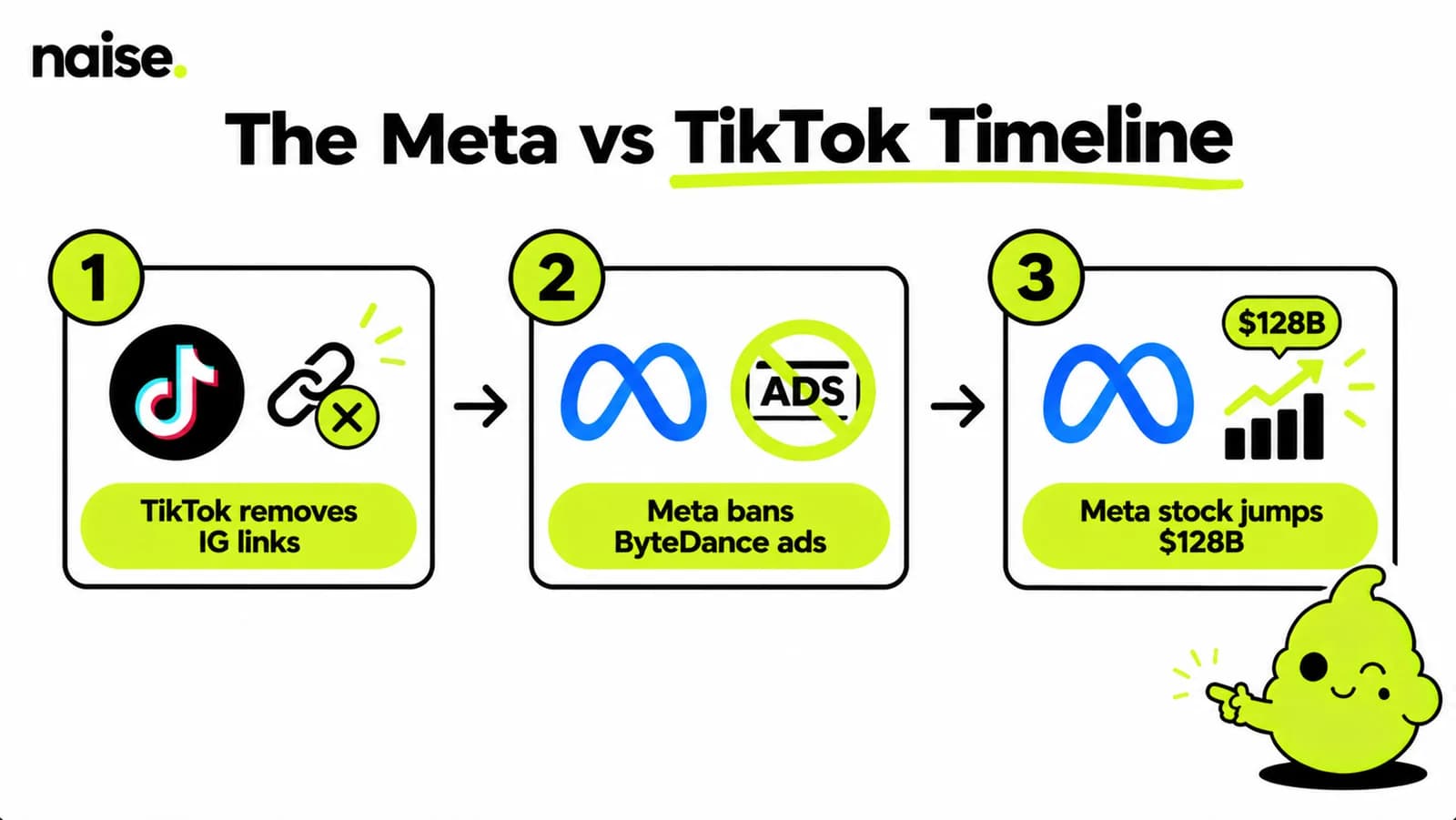
The ban is a direct retaliation against TikTok removing dedicated Instagram links from user profiles, combined with Meta fiercely protecting its $145 billion investment in artificial intelligence.
Tensions between these two tech giants have been simmering for years, but recent actions forced a boiling point. Just last month, TikTok introduced platform changes that made it incredibly difficult for users to connect with rival social platforms. They specifically removed dedicated Instagram links from user profiles. Meta viewed this as a direct attack on their organic traffic flow and responded with the ultimate trump card by cutting off TikTok from one of the world's largest digital advertising networks.
Furthermore, Meta is currently flexing massive financial muscle to dominate the future of technology. The company recently announced it has reached the AI frontier and is actively spending $145 billion this year alone to maintain that lead. Investors are heavily backing this AI push ahead of upcoming earnings reports. Meta simply refuses to let ByteDance leverage Facebook ad infrastructure to fund its own competing algorithms.
TikTok added roughly 300 million monthly active users between early 2025 and early 2026, reaching about 1.9 billion users—an annual growth rate of approximately 19%. By contrast, Instagram’s overall daily active user base grew by about 2% year over year, although Meta does not separately report daily active users for Reels. This gap underscores why Meta has become increasingly protective of Instagram’s audience, ad ecosystem, and Reels-driven engagement as TikTok continues to expand globally. This fierce competition for user engagement, creator loyalty, and advertising dollars means neither platform can afford to leak traffic. For Meta, enabling a competitor's growth through their own Meta Ads Manager was a mathematical flaw they finally chose to correct.
The Immediate Fallout for Social Media Marketers
Marketers can no longer use Meta Ads Manager to drive cheap, targeted traffic to TikTok profiles, forcing brands to rely entirely on native organic growth on both platforms.
This policy change immediately breaks countless marketing funnels across the globe. For years, creative agencies and brands used the highly sophisticated targeting of Meta Ads Manager to run campaigns promoting TikTok accounts. It was a reliable tactic to inflate follower counts, boost creator partnerships, and drive app downloads. Those advertisers must now completely halt and review any active campaigns that attempt to send users from Meta platforms to ByteDance properties.
The days of cross-platform paid arbitrage are officially over. You can no longer buy cheap attention on Facebook and comfortably export it to your TikTok funnel. Brands will now have to rely entirely on native advertising tools within each specific app to generate paid reach. This forces marketing teams to split their budgets and manage entirely separate paid ecosystems, hurting overall Return on Ad Spend (ROAS).
This separation creates a massive headache for the overworked marketing manager trying to maintain a unified brand presence. Without the crutch of paid cross-pollination, your organic content strategy on both platforms must be absolutely flawless. You have to understand exactly what the native algorithms want and deliver it consistently without burning out your creative team.
How to Pivot Your Strategy When Cross-Platform Paid is Dead
To survive the ad ban, marketers must execute ruthless account diagnostics, benchmark their performance against competitors, and double down on organic platform-native content.
If you can no longer pay to force users across platforms, you have to earn their attention natively. This requires a deep, uncompromising look at your current organic performance. Marketers must shift their focus toward rigorous account diagnostics to identify exactly which Content Pillars are actually resonating with their audience. You need to know if your audience mathematically prefers short-form Instagram Reels or detailed educational carousels.
Benchmarking against your competitors is no longer optional in a walled-garden ecosystem. You need to run head-to-head comparisons to uncover the structural differences in their strategy. Analyzing their Hook Opening effectiveness and posting cadence will reveal the gaps in your own approach. If a rival is capturing all the attention organically, you need the data to understand exactly how they are doing it.
Instagram’s average organic brand engagement rate is 0.48% in 2026, down 24% year over year (Socialinsider, based on 35 million posts across 447,613 accounts). Relying on gut feeling to plan your content calendar is a guaranteed way to lose market share. Marketers need automated tools to scrape live trending industry hashtags and analyze cross-platform viral posts instantly. You must reverse-engineer what works and apply it to your own brand voice seamlessly.
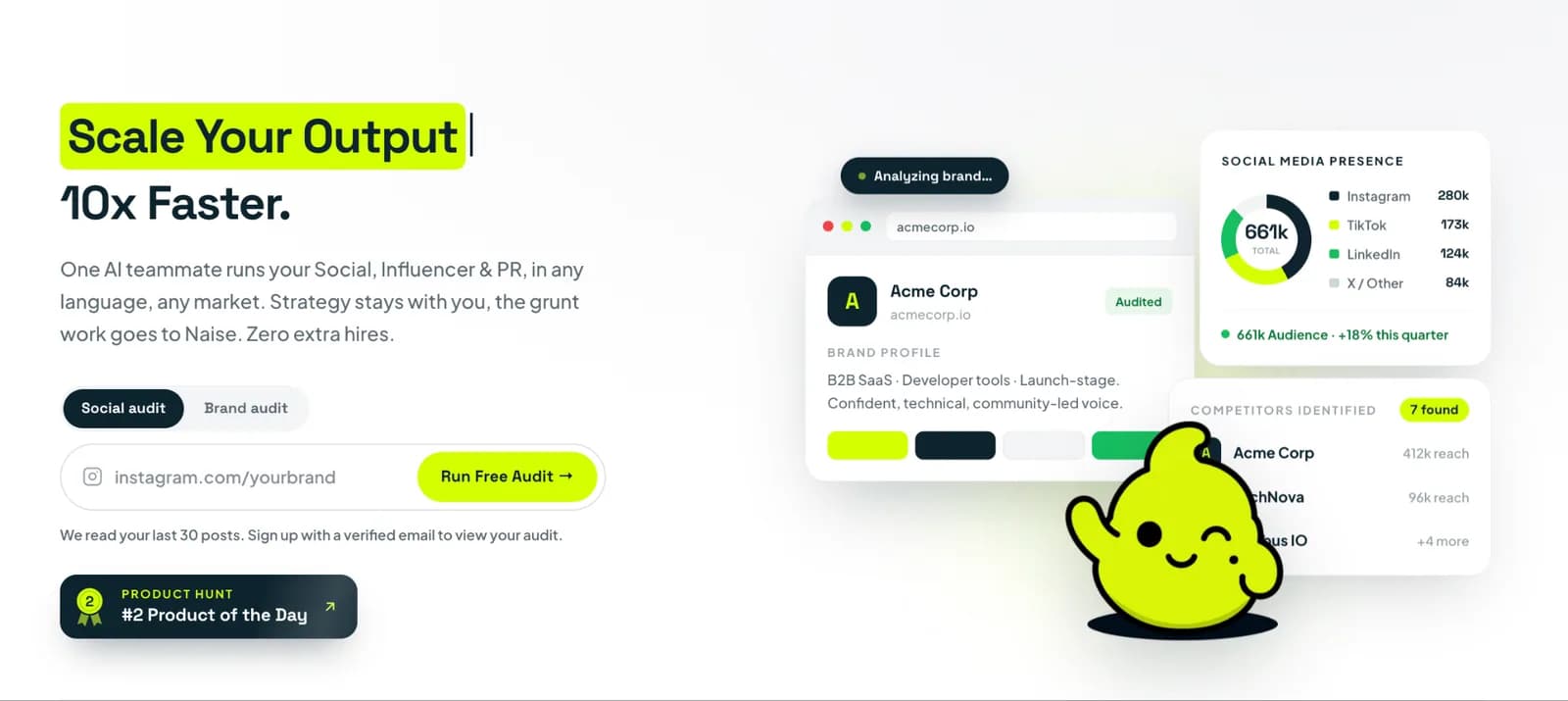
Automate Your Organic Rebound with Naise AI
The Naise AI Social Audit feature instantly diagnoses your Instagram performance across five critical pillars and seamlessly deploys autonomous agents to execute the necessary strategic fixes.
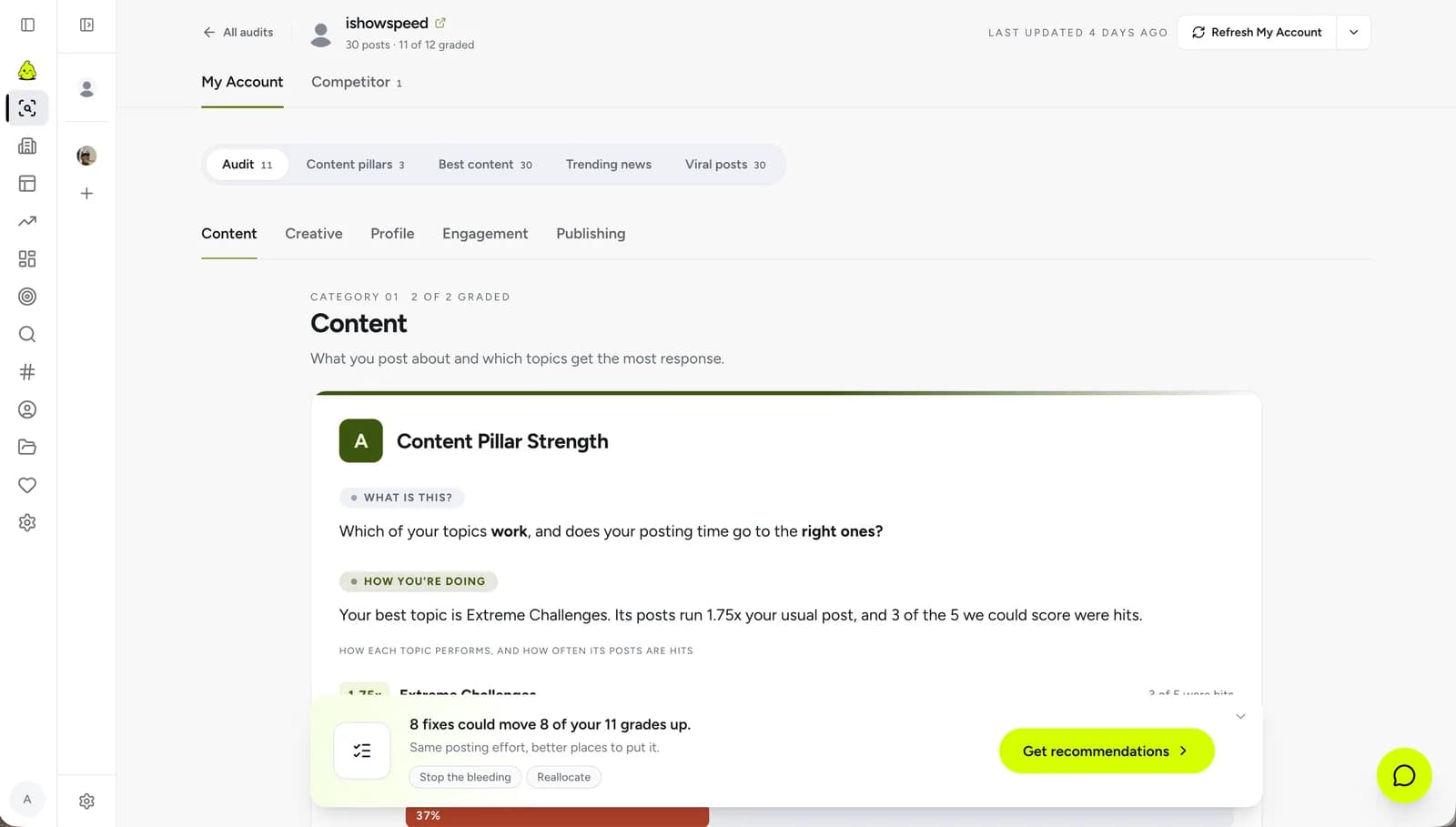
Transitioning to a purely organic growth strategy does not mean you have to drown in manual data entry. The Naise AI Social Audit is an automated diagnostic tool built to evaluate your account performance instantly. By simply pasting your Instagram URL, the system scans your last 30 posts and grades your account across five core pillars. It checks your Content Pillar Strength, Format Fit, and Post Consistency to highlight exactly where you are losing potential followers.
Once the audit reveals your blind spots, you do not have to fix them alone. Under the recommendations tab, you simply select a goal like "Increase my views" and click "Build this strategy in chat." This instantly transfers your audit data into your central Dashboard. Here, your dedicated Social Media Agent takes over the heavy lifting. It uses your saved brand guidelines within Projects to ensure every new piece of content sounds exactly like you.
You can select pre-configured Playbooks to bypass the blank page entirely. Your Social Media Agent will autonomously generate visual assets, draft engaging captions, and map out your new content calendar based on the audit's findings. You get the strategic depth of an entire marketing agency without the crushing overhead costs. Let the AI handle the manual execution, so you can clock out on time.
The digital walls are going up, and relying on paid ads to bridge the gap between platforms is a dead strategy. Meta is protecting its turf, and brands that fail to adapt their organic workflows will simply disappear from the feed. You need deep insights and lightning-fast execution to win the organic attention war. Stop wasting hours guessing what your audience wants and let automation do the heavy lifting.
Audit Your Social Strategy for Free
FAQs
What countries are affected by the Meta ban on TikTok ads?
The ban implemented by Meta restricts ByteDance from running ads in the United States, Canada, Egypt, Indonesia, Japan, Thailand, and Vietnam. This applies to both direct ByteDance campaigns and third-party advertisers linking to TikTok.
Why did Meta stock increase after banning TikTok ads?
Meta's stock jumped nearly 7%, adding $120 billion in value, because investors viewed the ban as a strong defensive move to protect user engagement. The market is also heavily optimistic about Meta's massive $145 billion investment in AI infrastructure.
Can I still link to TikTok from my Instagram bio?
Yes, organic profile links are still functional. The current Meta ban strictly applies to paid promotional services, advertisements, and marketing messages originating from the Meta Ads Manager.
How does the Naise AI Social Audit help with organic growth?
The Naise AI Social Audit instantly analyzes your last 30 posts to grade your performance across five pillars. It identifies your strongest Content Pillars and allows you to seamlessly deploy a Social Media Agent to automate content creation based on those data-driven insights.