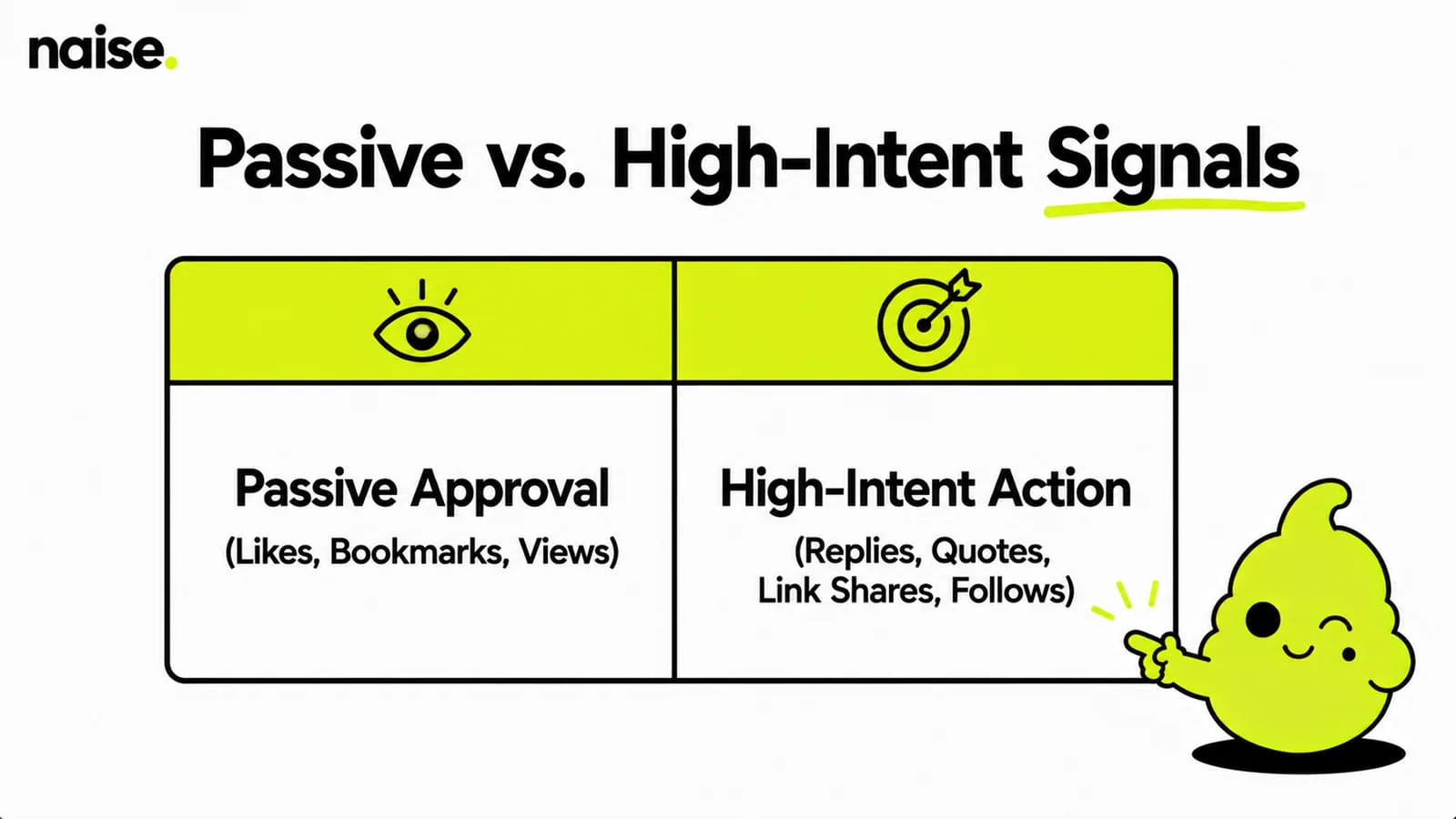
The rules for ranking on X have fundamentally changed. The X algorithm growth formula 2026 shifts the focus entirely from passive approval (likes) to high-intent actions (replies, quotes, and shares). If you want your content to hit the For You page, you must design posts that provoke a response, not just a nod of agreement.
The Shift from Approval to Action
The new X algorithm ranks posts based on the predicted probability that a viewer will take a high-intent action like replying, quoting, or sharing rather than just passively liking the content.
For years, the standard playbook for Twitter growth was simple: post consistently, farm likes, and hope for a retweet from a larger account. The algorithm functioned primarily as an echo chamber, heavily weighting follower relationships and the sheer volume of passive engagement.
However, the latest iterations of the X algorithm have completely rewritten this logic. The current For You system operates as a sophisticated prediction engine. It pulls posts from both followed and unfollowed accounts and calculates a score based on what a viewer is most likely to do next.
According to X's own open-source repository, the algorithm assigns specific ranking weights to predicted actions. Crucially, these weights are applied to the probability of an action, not the raw public counts. This means it is no longer accurate to claim that "one reply equals ten likes" in a literal sense. The system is far more dynamic, rewarding content that actively drives user behavior rather than just collecting static metrics.
Q3 2026 data from X's open-sourced algorithm (August 13, 2026 release) shows that a reply carries a weight of 5.0—10× the 0.5 weight of a like—while a reply from a mutual follower on an original post reaches 20.0, or 40× a like. This means posts that generate high reply-to-like ratios receive 10–40× more algorithmic scoring than posts with equivalent engagement composed primarily of likes, translating to substantially higher predicted reach in the For You feed.
High-Intent Engagement is the New Currency
Likes still provide a baseline signal, but the algorithm heavily prioritizes replies, quotes, shares, and follows because they prove the content successfully motivated the user to act.
The biggest takeaway for modern marketing teams is that passive approval is no longer enough to trigger massive distribution. When a user simply taps the heart icon, they are signaling agreement, but they aren't necessarily contributing to the platform's overall time-on-site or conversational depth.
X wants to keep users engaged in active dialogue. Therefore, the algorithm disproportionately rewards high-intent engagement. When someone takes the time to write a reply, quote a post with their own commentary, or share the link privately, they are providing a much stronger behavioral signal. They are proving that the post struck a nerve.
The practical lesson here is straightforward: your Content Strategy must pivot. You must design posts to create a specific response. A strong X post today gives the reader something to add, a stance to debate, or a unique insight they feel compelled to share with their own network.
The Old Playbook vs. The New Playbook
The old algorithm relied on follower networks and fast likes, whereas the new prediction-driven algorithm rewards conversational formats, sharp opinions, and content designed to be forwarded outside your immediate audience.
Understanding the mechanical differences between the old Twitter algorithm and the new X system is critical for adapting your approach. The older model was highly dependent on recency and the immediate network of the poster. If your existing audience didn't immediately engage, the post died quickly. Viral breakouts were possible, but they almost always required an initial boost from a massive account.
The newer algorithm is a different beast entirely. It is prediction-driven. It assesses every single user and calculates how likely they are to reject or interact with a specific post, regardless of who posted it. It then ranks the content based on those expected actions.
This fundamentally changes how creators and brands should write. The old playbook rewarded safe, agreeable platitudes. The new X algorithm growth formula rewards posts that create stronger behavioral signals. This means leaning into useful disagreement, offering sharp, contrarian opinions, providing clear, actionable takeaways, and sharing personal examples. The best posts are now explicitly built for conversation and forwarding, signaling to X that the content deserves to be pushed far beyond the original author's follower graph.
The days of coasting on passive likes are over. The new X algorithm demands that marketers become conversation starters rather than just broadcasters. By understanding that the platform now prioritizes high-intent actions—replies, quotes, and shares—you can adapt your strategy to create content that actually moves the needle. Stop writing for agreement and start writing for engagement.
FAQs
How does the new X algorithm work in 2026?
The new X algorithm uses a prediction-driven model for its For You page. It calculates the probability that a viewer will take a specific action (like replying, quoting, or sharing) and assigns weights to those probabilities to determine the post's ranking and distribution.
Are likes still important on X?
While likes still provide a baseline signal of approval, they are no longer the primary driver of massive reach. The algorithm now heavily prioritizes high-intent actions that prove a post successfully motivated a user to interact deeply or share the content.
What type of content performs best on X now?
Content that sparks conversation and debate performs best. Posts offering sharp opinions, useful disagreement, clear takeaways, and unique insights encourage high-intent actions like replies and quotes, signaling to the algorithm that the content is highly engaging.