The Fragmentation Trap Crushing Your Agency
Operating with a fragmented multi-tool stack creates severe data silos, introduces operational friction, and prevents your team from moving fast.
It is completely understandable why cobbling together multiple tools feels like a necessary evil when building an agency. Many founders naturally start by combining Buffer for basic scheduling, Agorapulse for community management, and Iconosquare for deep reporting. However, this setup often turns into a terrifying operational friction loop.
Rather than focusing on strategy, your team ends up spending hours downloading data from one platform just to upload it into another. Data silos form instantly because these separate tools rarely communicate effectively with each other. Ultimately, a growing agency absolutely requires a single consolidated platform to maintain speed and accuracy.
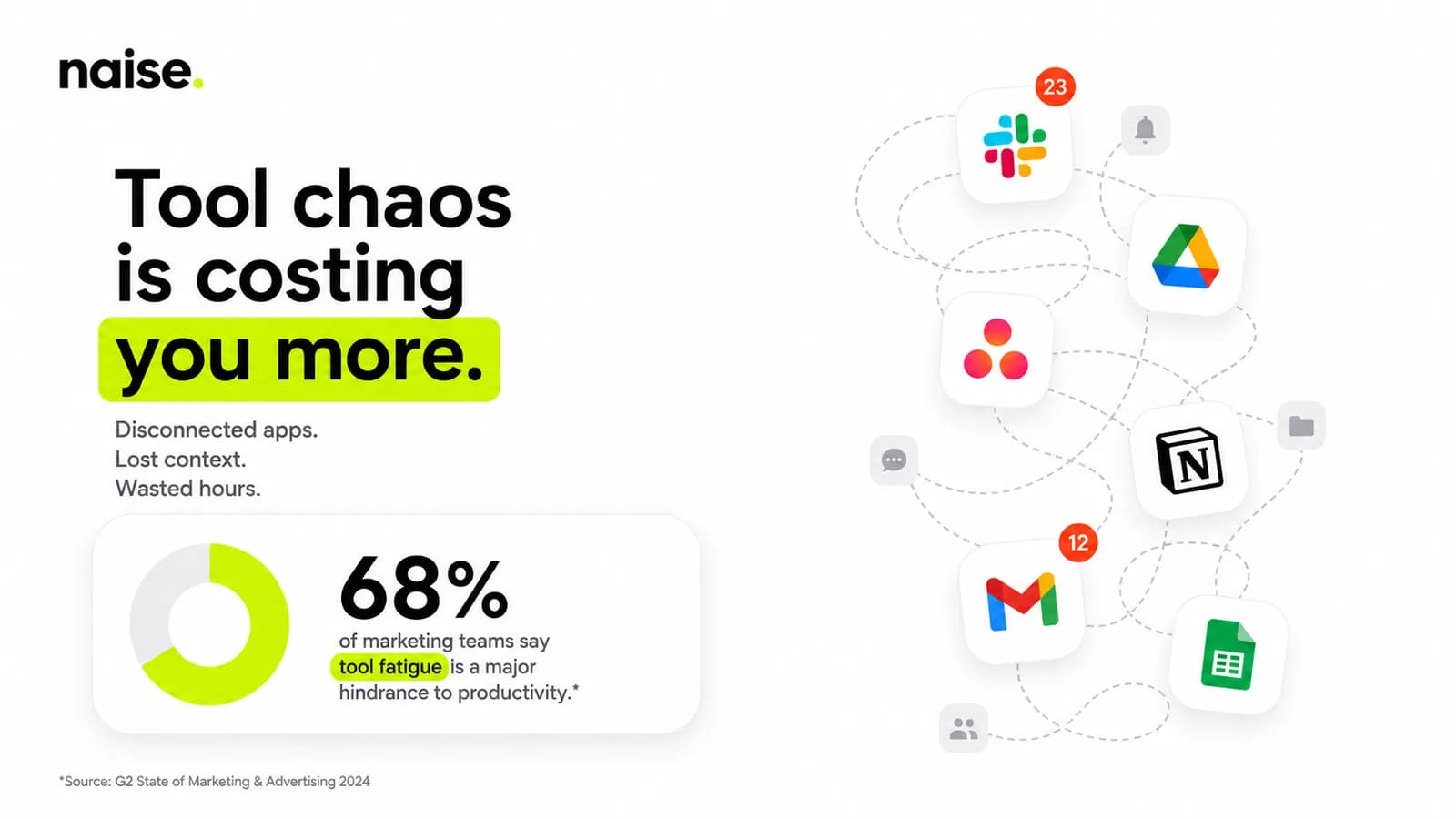
When account managers juggle six different logins to execute one client campaign, mistakes happen. They post the wrong graphic or miss a critical brand voice guideline. Centralizing your operations is the first step toward actual growth.
The Pricing Blindspot Eating Your Margins
Per-seat and per-profile pricing models aggressively erode agency profit margins, making flat-rate or unlimited-account platforms a mandatory requirement for scaling.
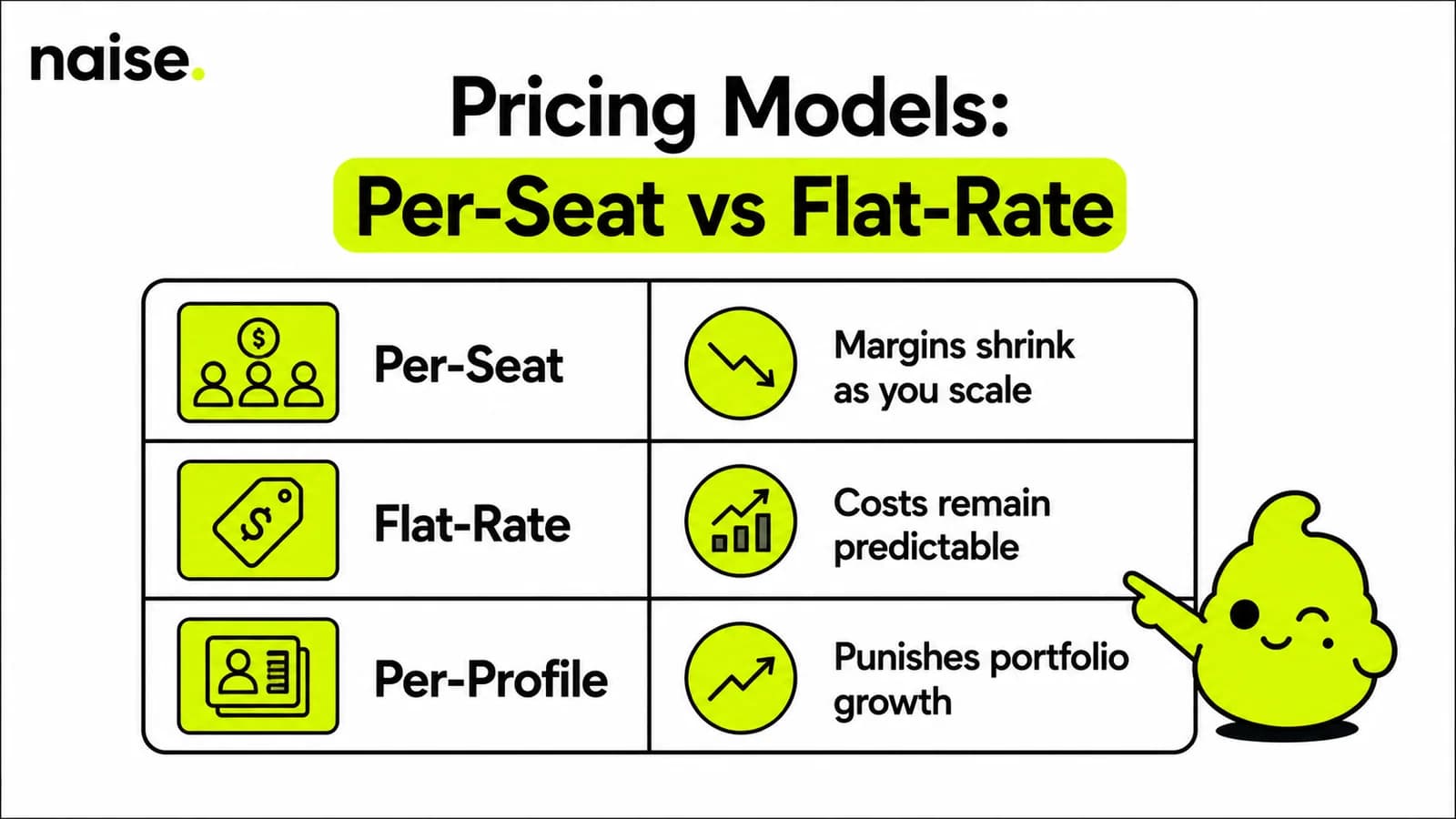
Most mainstream platforms punish you for growing. Legacy tools like Sprout Social or Hootsuite rely heavily on per-seat or per-profile pricing structures. This means every time you sign a new client or hire a new account manager, your overhead costs increase automatically.
Scaling an agency requires predictable expenses. If your software costs scale linearly with your revenue, your profit margins remain razor-thin. Agencies must seek out platforms offering flat-rate pricing or unlimited-account models.
This financial blindspot kills more agencies than bad client retention. You need software that allows you to add ten new team members without triggering a massive software bill the next month.
Overlooking Agency-First Workflows
Generic software ignores multi-tenant agency workflows, making dedicated middle-tier platforms with white-labeling and approval dashboards essential.
Not all software respects the agency-client dynamic. Mainstream tools often lack dedicated multi-tenant agency workflows. This means you cannot safely separate client assets, increasing the risk of posting Brand A's content onto Brand B's account.
Smart agencies look toward platforms built explicitly for their business model, such as Cloud Campaign or HeyOrca. These tools prioritize client approval dashboards out of the box. They allow you to send a clean, branded link to a client for easy content sign-off.
Furthermore, white-labeling capabilities help you maintain a premium image. Presenting reports and approval matrices under your own domain builds trust. It proves you run a sophisticated operation.
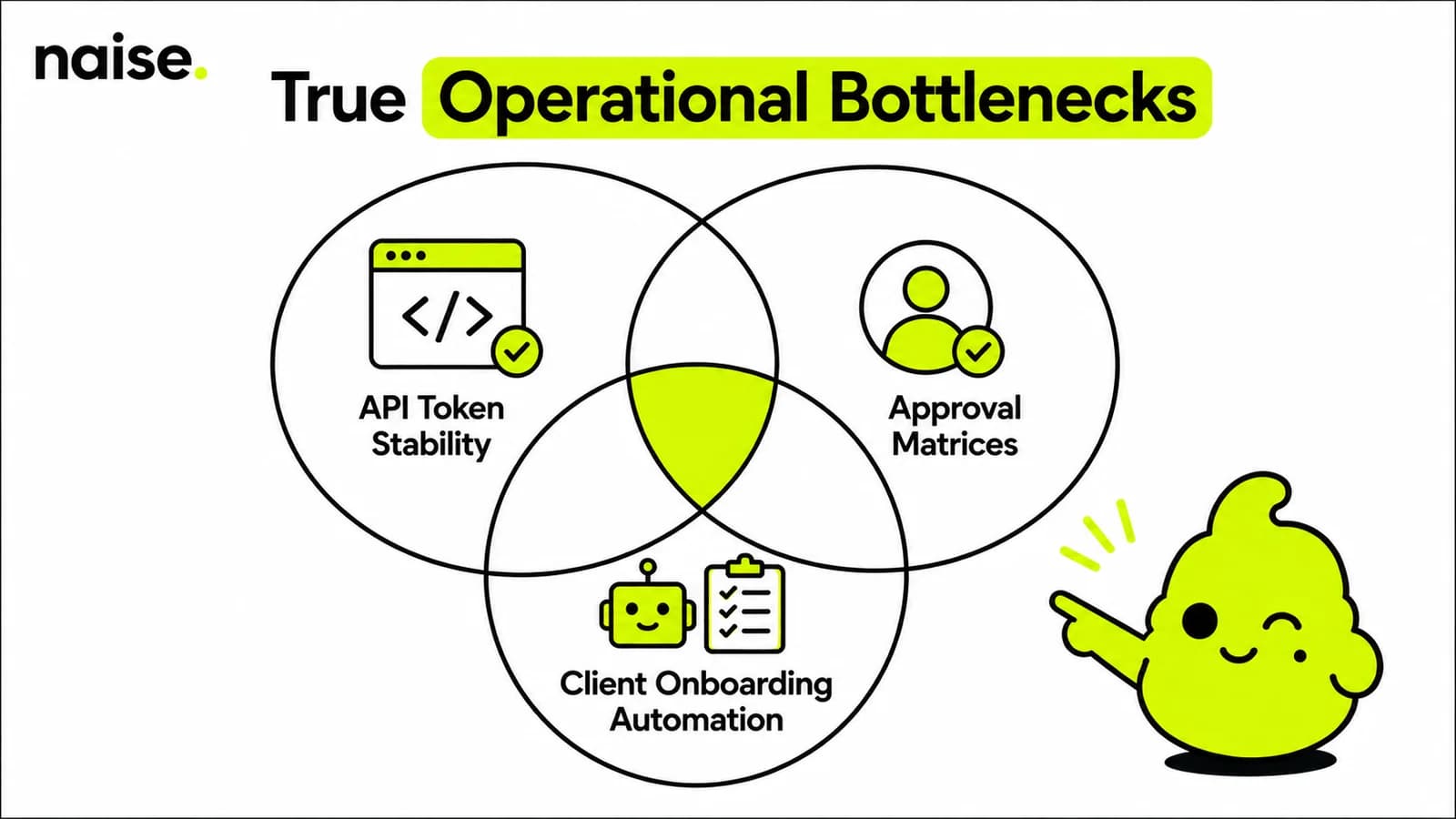
Ignoring True Operational Bottlenecks
Superficial features like basic AI copywriters do not solve the actual breaking points of scaling, which include onboarding automation and API stability.
Many software companies sell the dream of built-in AI copy assistants. However, generating a clever caption is rarely the actual bottleneck for a scaling agency. The true breaking points happen deep within your operational infrastructure.
You need robust client onboarding automation to ingest new brand guidelines quickly. When a new client signs, your team needs their tone of voice, visual assets, and banned keywords centralized immediately. Relying on scattered Google Docs leads to disastrous off-brand posts.
Additionally, you must prioritize frictionless approval matrices and API token stability. If a tool constantly drops its Instagram connection, your team spends hours manually reconnecting accounts instead of strategizing. Focus on infrastructure, not just flashy gimmicks.
The Missing Regional Context
Global software often ignores critical localized requirements like native messaging integrations and purchasing-power-adjusted pricing for non-Western markets.
Many top-tier platforms are built strictly with a Western market in mind. This creates massive friction for agencies operating in Southeast Asia, Latin America, or the Middle East. A perfect example is the absolute necessity of native WhatsApp Business integrations for client communication and community management in these regions.
Regional support time zones also dictate your success. If your scheduling tool goes down at 9 AM in Jakarta, waiting for a New York support team to wake up is unacceptable. Your clients expect immediate resolutions.
Finally, pricing must reflect regional purchasing power. Paying premium USD rates for standard features puts non-Western agencies at a severe competitive disadvantage. You must audit a platform's commitment to global localization before migrating your entire team.
The Old Way vs. The Automated Way
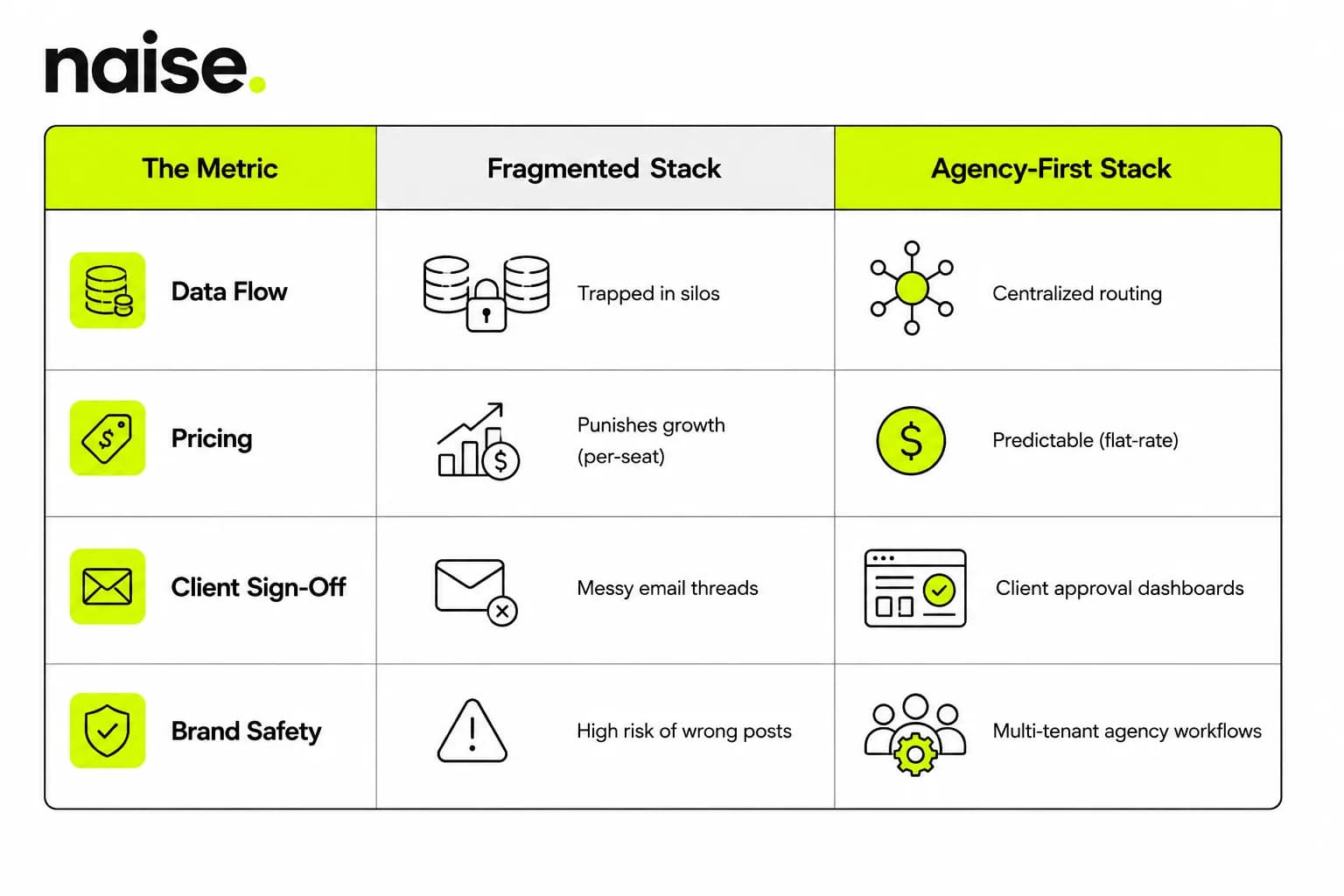
Here is a breakdown of how a fragmented stack compares to a consolidated agency approach.
Scale Without the Overhead Using Naise AI
Naise AI centralizes your entire agency workflow by utilizing persistent memory banks and autonomous agents to execute campaigns instantly.
Ditching a fragmented stack requires a platform that actually understands context and execution. Naise AI acts as your 24/7 AI Marketing Operator, eliminating the busywork that destroys your margins. Here is how you can manage multiple clients effortlessly without hiring a massive team.
Upload Context to Projects: Treat Projects as your persistent memory bank. Upload your client's brand guidelines, past PDFs, and tone of voice rules once. The AI memorizes this context permanently.
Command via Naise Chat: Open Naise Chat, your central command interface. You never have to re-explain the brand to the AI again.
Select Expert Playbooks: Stop staring at a blank screen. Choose from pre-configured Playbooks (like 'Organic Spillover Capture' or 'Product Story Arc'). These load expert prompt templates instantly.
Deploy the SMM Agent: Delegate the heavy lifting to the SMM Agent. It locks in the brand identity, generates on-brand visual assets, and uses direct account integration to schedule and autopost across platforms instantly.
Finding the best software for scaling a social media agency comes down to execution speed and cost predictability. You must eliminate data silos, avoid per-seat pricing traps, and demand tools built for multi-tenant agency workflows. When you consolidate your stack, your team stops acting like data-entry clerks and starts acting like strategists. Stop repeating context and start shipping campaigns 10x faster.
Frequently Asked Questions (FAQs)
Why is per-seat pricing bad for growing social media agencies?
Per-seat pricing inflates your overhead costs every time you hire, destroying profit margins. When software companies charge per user, your operational expenses grow linearly alongside your revenue. This prevents agencies from achieving true scale. You need flat-rate models that allow you to expand your team without financial penalties.
What are multi-tenant agency workflows?
These workflows allow agencies to securely separate different clients within a single software platform. Instead of mixing content and analytics in one messy dashboard, a multi-tenant architecture gives each client their own secure environment. This prevents cross-posting errors, secures client data, and enables clean white-labeling for client approval dashboards.
How does an SMM Agent differ from a standard scheduling tool?
An SMM Agent actively generates and curates on-brand content autonomously, rather than just waiting for you to upload it. While legacy tools require you to manually draft, upload, and format every single post, an autonomous agent understands your brand guidelines through persistent memory. It handles the creative drafting and direct scheduling, acting as an extension of your team rather than just a calendar interface.